


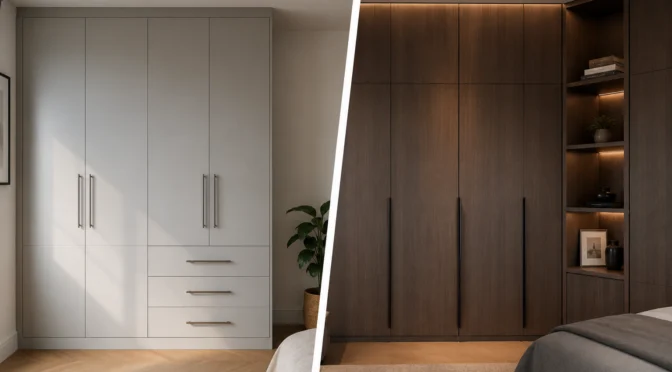
If you are planning a bedroom, kitchen, or living room upgrade, at some point you will face this key decision. Do you invest in bespoke joinery designed specifically for your space, or do you go with a standard fitted furniture range from a retailer?
Both options undoubtedly have their place. The right choice depends on your budget, your property, and what you actually need the furniture to do. Here is an honest, straightforward breakdown of both options to help you navigate your upcoming project.
What Is the Real Difference Between Bespoke Joinery and Fitted Furniture?
Standard fitted furniture, from major high-street retailers such as IKEA, Hammonds, or Sharps, uses modular units built to standard, pre-set sizes. They are designed to fit most typical rooms reasonably well and come at a highly predictable, budget-friendly price point.
On the other hand, Bespoke joinery design is planned, crafted, and built completely from scratch around your exact room layout. Every single dimension, material, internal configuration, and decorative finish is decided specifically for your room, rather than being adapted from a pre-made catalogue.
The distinction sounds simple on paper, but the practical difference in your home is incredibly significant.
Why Does Standard Fitted Furniture Often Fall Short in London Homes?

London properties are rarely straightforward. Victorian terraces have alcoves that are never quite symmetrical, whilst Edwardian conversions have ceiling lines that slope at unexpected angles. Modern flats often feature structural columns, steel beams, and air conditioning units that sit exactly where a standard wardrobe is supposed to go.
Standard fitted furniture is designed for perfectly regular, modern square rooms. Truthfully, most London rooms are anything but regular.
The inevitable result of using standard units is visible gaps, clumsy filler panels, shimmed bases, and wardrobes that never quite sit flush against the wall. In a room that has been otherwise beautifully designed, these compromises stand out immediately.
Bespoke joinery eliminates every single one of these problems. It is built to the actual, real-life dimensions of the room, accounting for every quirk and irregularity—so the finished result looks as though the furniture and the architecture were always meant to coexist.
Why Are London Homeowners Increasingly Choosing Bespoke Joinery?
Beyond achieving a perfect fit, there are several key reasons why London homeowners consistently choose custom design over off-the-shelf fitted ranges.
Structural quality. Bespoke joinery utilises solid timber frames, high-quality carcass materials, and traditional joinery techniques, whereas standard fitted furniture relies heavily on cheap MDF and particleboard with veneered or wrapped finishes. This structural difference directly affects the furniture’s longevity in a high-use household environment.
Full design control. With custom cabinetry, every single decision is entirely yours. From the finish colour, hardware, and internal fittings to drawer configurations and integrated LED lighting, nothing is limited by what happens to be in a retailer’s inventory. If you are looking to source high-end, elegant bespoke furniture in London, having this level of creative freedom is priceless.
Property value. Well-specified bespoke joinery adds measurable, tangible value to a London home. It is consistently cited by estate agents as a premium feature that buyers immediately notice and factor into their offers, particularly in prime London postcodes where finishing standards are heavily scrutinised. This is particularly true when paired with sophisticated bedroom wall panelling ideas that elevate the space from standard to extraordinary.
To understand more about what bespoke joinery actually involves before committing to a project, our guide on what is bespoke joinery covers the process, materials, and what to expect from start to finish.
What Do Bespoke Joinery and Fitted Furniture Actually Cost?
This is the question most homeowners ask first, and understandably so. Bespoke joinery costs more than fitted furniture, with the financial gap depending entirely on the scope and specification of the project.
A straightforward set of fitted alcove units in a quality retail range might cost £1,500 to £3,000. A bespoke equivalent—designed to the exact dimensions of the room, in a specified hand-painted finish, with quality brassware—will typically cost £3,000 to £7,000 for the same footprint.
For wardrobes, a standard fitted wardrobe from a specialist retailer runs £2,000 to £5,000. A bespoke, floor-to-ceiling wardrobe wall with integrated sensor lighting and a custom internal layout runs £8,000 to £20,000 depending on the materials used.
The full picture of bespoke joinery costs in London, broken down by room type and specification level, is worth reviewing before you make any final decisions. The numbers are often more accessible than most homeowners expect, particularly when long-term durability and property value uplift are factored into the equation.
When Is Standard Fitted Furniture Actually the Right Choice?
Fitted furniture is certainly not always the wrong answer. In fact, there are many situations where it makes complete practical sense.
If your budget is genuinely limited and the room in question is a secondary bedroom or a low-priority guest space, a quality fitted range delivers a highly reasonable result at a manageable cost. Similarly, if the property is a rental investment where finish quality needs to be functional rather than aspirational, standard fitted furniture is a perfectly sound, practical choice.
The key is being honest about what the space needs. Fitted furniture in the primary bedroom of a well-designed London home tends to look like a compromise, because it is. However, in a guest room or a home office that only sees light use, it can be entirely appropriate. For a complete room overhaul, such as a major master bedroom renovation in London, coordinating custom joinery with the wider architecture is usually the most rewarding path.
How Can You Decide Which Option Is Best for Your Property?
Ask yourself three essential questions before making your choice:
First, is the room a regular shape with standard dimensions? If yes, fitted furniture may work beautifully. If no, bespoke is almost certainly required for a successful, flush result.
Second, is this a high-visibility room where the quality of the finish directly affects how the whole interior feels? If yes, invest in bespoke. If no, a quality fitted range may be completely sufficient.
Third, are you planning to stay in the property long term, or are you selling within the next few years? If staying, bespoke joinery easily pays for itself in daily quality of life and functionality. If selling, it pays for itself in increased market appeal and property value.
Are You Ready to Design the Perfect Solution for Your Space?
A good interior design company will always give you an honest view on which route is right for your specific project, rather than simply defaulting to the most expensive option regardless of your brief.
If you are currently weighing up bespoke joinery for a room in your London home and would like to discuss the options with our team, book a free consultation with Oraanj Interiors. We will help you make the right call for your space, your lifestyle, and your budget.

