


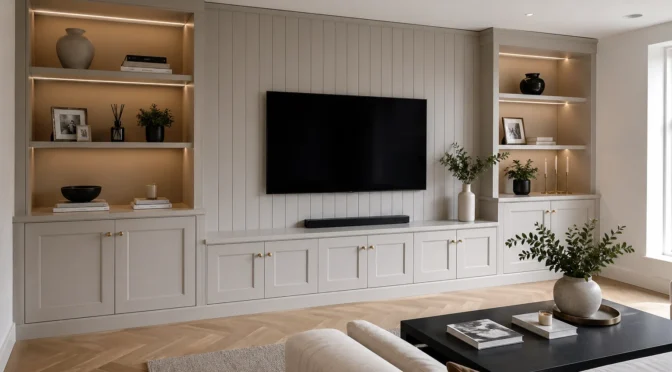
When it comes to creating a home that feels truly individual, nothing delivers quite like bespoke joinery design. Unlike mass-produced furniture that is designed to fit as many rooms as possible, bespoke joinery is designed and built specifically for your space, your taste, and your lifestyle. For London homeowners, where no two properties are alike, room proportions can be awkward, and the standard of finish matters enormously, bespoke joinery is increasingly the standard rather than the exception. This guide covers everything you need to know before starting a project.
What Is Bespoke Joinery and How Is It Different From Standard Furniture?
Bespoke joinery refers to furniture, cabinetry, and architectural woodwork that is designed from scratch and hand-crafted to precise specifications. Every dimension, material, finish, and detail is decided in collaboration with the client rather than selected from a catalogue.
The distinction from standard furniture is significant. Off-the-shelf units come in fixed sizes, limited finishes, and generic proportions. They are built to a price point and manufactured at volume. Bespoke joinery, by contrast, is built to fit, a specific alcove, a particular ceiling height, a corner that no standard wardrobe will ever sit in neatly. The result is furniture that looks as though it grew with the room, not furniture that was placed into it.
Custom built furniture also uses higher-grade materials and traditional joinery techniques, mortise and tenon joints, hand-fitted dovetails, solid timber frames, that simply are not present in flat-pack or even mid-range retail furniture. The structural difference is immediately apparent and it directly affects how long the piece lasts.
Why Choose Bespoke Joinery for Your London Home?

London properties present challenges that standard furniture is rarely equipped to handle. Victorian terraces have chimney breast alcoves that are never quite the same width on each side. Edwardian homes have cornicing that drops at odd angles. New builds in prime postcodes have open-plan layouts where every fitted element is on full display. Bespoke joinery solves all of these problems because it is made for the room, not the other way around.
Beyond practicality, the benefits of custom furniture for London homeowners include:
Maximum use of space. In a city where square footage is expensive, fitted bespoke joinery uses every centimetre, floor to ceiling, wall to wall, in a way no freestanding unit can replicate.
Cohesion across a scheme. When cabinetry, shelving, panelling, and fitted furniture are all designed together, the result is a home interior that feels considered and complete. This is why bespoke joinery works so naturally alongside a wider home design strategy rather than as an isolated purchase.
Long-term value. Well-made bespoke joinery adds measurable value to a London property. Estate agents consistently report that fitted bespoke storage, custom kitchen cabinetry, and bespoke bedroom furniture are features that buyers notice and pay a premium for.
Total design control. Finish, hardware, internal fittings, material species, every decision is yours. There is no compromise between what you want and what happens to be in stock.
What Are the Benefits of Custom Made Bedroom Furniture Specifically?

The bedroom is where bespoke joinery has the most transformative effect on daily life. Custom made bedroom furniture, fitted wardrobes, bedside cabinetry, storage beds, dressing tables, removes the clutter that freestanding furniture creates and replaces it with clean, purposeful storage that is built around how you actually live.
For London bedrooms, which are frequently smaller than homeowners would like, bespoke fitted furniture makes rooms feel significantly larger. Running wardrobes from wall to wall and floor to ceiling with recessed handles and no visible gaps creates a streamlined effect that mirrors and clever lighting then amplify further. A well-designed custom bedroom can feel like a genuine suite rather than just a room with a bed in it, and for properties in Kensington, Chelsea, or Mayfair where letting values are considered, that distinction matters enormously.
Custom built furniture in bedrooms also means you can design the interior of every unit. Shoe racks, pull-out trouser rails, integrated laundry hampers, jewellery drawers, the internal specification is entirely yours, designed around what you actually own and need to store.
How to Integrate Lighting Into Bespoke Joinery

One of the most underused opportunities in any joinery project is integrated lighting, and it is one of the details that most clearly separates a high-end result from a standard fit-out. Integrating lighting into bespoke joinery transforms furniture from a purely functional element into something that actively contributes to the mood and atmosphere of a room.
The most common and effective approaches include:
Under-cabinet lighting in kitchens and media units, which illuminates worktops and surfaces without harsh overhead glare.
Interior wardrobe lighting triggered by door sensors, which makes the entire contents visible immediately and adds a retail-quality finish to a domestic space.
Plinth and kickboard lighting beneath island units or low cabinetry, which creates a floating effect and adds warmth to hard floor surfaces.
Backlit shelving and display niches, which draw the eye to specific objects and add depth to flat wall-mounted joinery.
Done well, integrated joinery lighting works in complete harmony with the wider lighting scheme of a room. This is why at Oraanj, we coordinate bespoke joinery design directly with our lighting design London services so that every shadow, highlight, and ambient effect is considered as part of a single, cohesive brief rather than added as an afterthought.
Is Bespoke Joinery Only for Residential Projects?

Not at all. Designers working on offices, hospitality venues, and retail spaces rely heavily on bespoke joinery to create environments that are both functional and brand-consistent. Reception desks, custom office storage, built-in meeting room cabinetry, and bespoke bar and restaurant furniture all fall within the scope of a skilled joinery company.
For London businesses investing in their physical workspace, the same logic that applies residentially holds commercially, generic furniture rarely fits the space, the brand, or the expectation of clients and staff. Our commercial interior design service integrates bespoke joinery as a core part of the commercial fit-out process, ensuring that every element serves the brief with precision.
How to Start a Bespoke Joinery Project in London?
The process begins with a measured survey of the space and a detailed brief covering how the furniture will be used, what needs to be stored, and what aesthetic you are working towards. A reputable bespoke joinery company will then produce detailed drawings for approval before anything is made, so you can visualise exactly what you are commissioning.
Lead times for quality bespoke joinery in London typically run between six and fourteen weeks from sign-off to installation, depending on complexity and the joinery workshop’s current schedule. The best makers are always booked ahead, so if you have a project in mind, the right time to make an initial enquiry is earlier than you think.

