


If you are taking on commercial space in the capital, you will hear the terms CAT A and CAT B immediately. Landlords, commercial agents, and fit out contractors london use them constantly—often assuming you already know what they entail.
This guide explains what CAT A and CAT B include, what they cost, and how to plan a successful office design and fit out through an expert london office fit out without costly surprises.
What Exactly Is a CAT A Office Fit-Out?

A cat a fit out (Category A) is the base-level office fit out delivered by a landlord before occupation. It takes a shell-and-core space—bare concrete floors and exposed structure—and brings it to a clean, functional standard.
A typical cat a office fit out includes:
- Raised access flooring
- Suspended ceiling grid with basic lighting
- Mechanical and electrical services—heating, ventilation, air conditioning
- Fire detection and sprinkler systems
- WC facilities
- Basic reception area finish
What CAT A does not include is anything that reflects how the occupying business works. There are no partitions, meeting rooms, branding, furniture, or design. It is a functional blank canvas.
Some landlords offer a CAT A+ spec, which adds basic furniture and finishes to attract tenants. This is not an industry standard and varies significantly across developments.
What Is a CAT B Office Fit-Out and How Does It Differ?

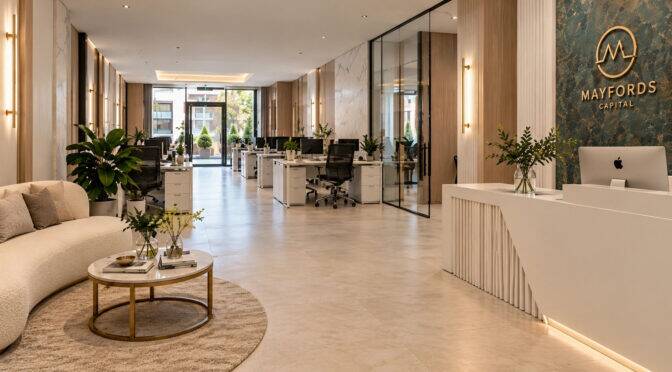
A cat b fit out london transforms a base shell into an operational workplace. For tenants undertaking an office interior fit out, aligning plans with modern office interior design trends creates an inspiring, future-proof environment.
A comprehensive cat b office fit out includes:
- Space planning and interior design
- Partitioned meeting rooms, offices, and breakout areas
- Bespoke reception and front-of-house design
- Flooring upgrades, carpet, timber, luxury vinyl tile
- Feature lighting and architectural lighting schemes
- Branded wall finishes, graphics, and decorative elements
- Kitchen and staff amenity areas
- IT and AV infrastructure
- Furniture, workstations, and storage
- Bespoke joinery, reception counters, and storage walls
In any cat b office fit out london, design choices directly impact staff productivity and brand perception. Delivering a high-standard office interior fit out london requires an informed brief, structured procurement, and expert project management.
For a full breakdown of planning a productive workplace, our guide to commercial office design in London covers how layout decisions drive long-term commercial performance.
CAT A vs CAT B: What Is the True Practical Difference?
The simplest distinction is this: CAT A is what you inherit; CAT B is what you build.
A business taking on a CAT A shell must commission a full CAT B fit-out before occupying the space. A company moving into a pre-fitted CAT A+ space may require only custom furniture, branding, and IT to become operational.
Establishing your starting point is one of the first questions an experienced office interior designer will evaluate to define your scope and budget.
How Much Does a CAT A Fit-Out Cost in London?
Understanding cat a fit out costs is essential when negotiating commercial leases. Landlord-funded cat a office fit out costs in London typically range between £35 and £80 per square foot depending on building grade and M&E infrastructure.
When a tenant covers CAT A baseline works—common in shell-and-core agreements—budget £40 to £75 per square foot for standard commercial specifications.
What Is the CAT B Office Fit-Out Cost Per Square Metre in London?
When asking how much will my office fit out cost, you must evaluate baseline cat b fit out costs alongside wider office space london cost per square foot benchmarks.
To evaluate your expected office fit out cost, explore our London office fit-out cost guide for 2026 benchmarks:
- Basic CAT B fit-out: £60 to £90 per square foot (approx. £650 to £970 per square metre)
- Mid-range CAT B fit-out: £90 to £130 per square foot (approx. £970 to £1,400 per square metre)
- High-specification CAT B fit-out: £130 to £200+ per square foot (approx. £1,400 to £2,150+ per square metre)
Evaluating typical office fit out costs on both an office fit out costs per square foot and office fit out costs per square metre basis ensures accurate financial forecasting. For a comprehensive turnkey route, your overall design and build office fit out cost will also reflect bespoke furniture and tech integration.
For a transparent breakdown of the full cost of office fit out, our guide to office fit-out costs in London analyzes every financial category.
What Typically Drives CAT B Office Fit-Out Costs Up?
Key variables that influence overall office fit out costs include:
Partitioning. Glass-fronted meeting rooms and acoustic partitioned offices add cost quickly. Full-height acoustic glass can cost £600 to £1,200 per linear metre for a quality commercial specification.
Reception and front-of-house. Concentrating bespoke joinery, architectural lighting, branding, and premium flooring in entrance zones drives square-metre rates well above the general office average.
Breakout and amenity areas. Fitted teapoints, café-style breakout spaces, and wellness hubs require specialist mechanical input, contributing disproportionately to overall spend relative to floor area.
M&E modifications. Altering inherited primary services—relocating air conditioning fan coils, increasing electrical capacity, or extending sub-floor cabling—incurs separate trade costs.
Furniture and specification. Underestimating office furnishing cost during concept planning leads to budget strain. Workstations, task seating, and bespoke breakout pieces must be coordinated alongside spatial plans from day one.
How Long Does a CAT B Office Fit-Out Take to Complete?
Programme duration is critical for tenants paying rent during capital works. Realistic on-site construction timelines:
- Small office (under 2,000 sq ft): 6 to 10 weeks on site
- Medium office (2,000 to 5,000 sq ft): 10 to 16 weeks on site
- Large office (5,000 sq ft+): 16 to 24 weeks on site
Pre-construction planning—including space planning, technical packages, statutory approvals, and contractor tenders—adds 8 to 14 weeks. Businesses should appoint design teams at least five to six months ahead of target completion.
For compact footprints requiring high efficiency, our guide to small office design in London outlines how strategic planning delivers maximum performance.
What Are the Common CAT B Fit-Out Mistakes London Businesses Make?

Tendering before design sign-off. Tender packages with incomplete technical specifications result in contractor provisional sums and costly variations during construction.
Separating design and project management. Disconnected design and delivery teams introduce coordination gaps between concept intent and physical installation.
Underfunding furniture packages. Treating FF&E as an isolated leftover budget undermines the workplace aesthetic and operational comfort.
Overlooking acoustics. Omitting acoustic ceiling panels, sound insulation, and quiet pods leads to noise transfer issues once occupied.
If you are preparing an office fit out london and require specialist advice, our portfolio across open-plan office design highlights our balanced commercial approach. If you are assessing whether is it time to redesign your office space, early engagement avoids costly oversights.
How Should You Plan Your CAT B Fit-Out?
Successful office transformations require early operational clarity. Establish your user brief, commercial budget (with contingency), and lease handover milestones before appointing contractors.
With these foundations in place, specialist designers ensure your workplace operates efficiently and supports business growth from day one.
If you are planning a CAT A or CAT B workspace in London, book a free consultation with Oraanj Interiors to plan an office designed for long-term commercial performance.

