


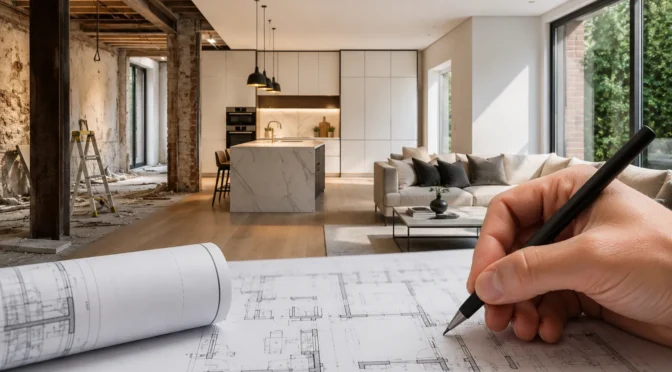
Most London renovation projects start the exact same way. Someone finds a designer whose style they love, browses endless mood boards, picks out gorgeous finishes, and assumes the rest of the puzzle will naturally fall into place. Then the actual project kicks off, and it quickly becomes apparent that the bones of the space—the walls, the flow, the core structure—were never properly thought through. If you are exploring a guide to property renovation in London, you will soon realise that aesthetics alone are simply not enough.
Trying to fix structural and design mistakes after construction has already started is notoriously expensive and incredibly stressful. Yet, solving these exact same issues at the architecture stage costs nothing more than an honest conversation.
How Does the Structure of a Space Determine Everything Else?

Interior finishes are usually the last thing that gets built, but they are undoubtedly the very first thing people notice. However, the true quality of any finished room is almost entirely determined by choices made long before a single tile is laid down or a wall is painted a fresh colour.
Think about how a room is proportioned, where natural light enters, and how you instinctively move from one space into the next. Consider whether a kitchen feels beautifully connected to a living area or completely cut off from it. These are fundamental interior architecture decisions. Once the builders have finished their work, altering these elements is virtually impossible without tearing everything apart again.
Collaborating with an interior architecture company at the very beginning of a renovation ensures these spatial decisions are made deliberately. It requires genuine skill and technical knowledge, rather than simply accepting whatever layout the previous owners happened to leave behind.
Why Do London Buildings Specifically Require an Architectural Approach?
London’s housing stock presents incredibly unique challenges. Whether you live in a Victorian terrace, an Edwardian semi, a Georgian townhouse, or a converted commercial building, each comes with its own spatial constraints, structural quirks, and planning sensitivities. Generic renovation advice simply does not account for these historical nuances.
Period properties, for instance, often hide load-bearing walls in the most unexpected places. Basement conversions demand meticulous structural coordination, while rear extensions in conservation areas need specific planning approvals. Furthermore, loft conversions must always comply with strict fire safety and building regulations.
None of this means these projects cannot be executed beautifully. In fact, many of our most striking residential interior design projects happen to be in exactly these types of historical properties. They just require proper architectural thinking from the outset, rather than acting as a frantic afterthought once the contractor is already on site.
What Does Interior Architecture Add to a Renovation Project?
Spatial clarity — This means achieving a clear floor plan that has been thoroughly interrogated and refined, rather than merely relying on the existing, outdated layout.
Technical precision — Providing highly detailed drawings that contractors can genuinely build from. This drastically reduces the ambiguity that typically leads to cost overruns and disputes.
Regulatory confidence — Ensuring that building regulations, party wall agreements, and complex planning considerations are handled correctly right from day one.
Design integration — Having interior architecture and interior design working seamlessly together guarantees that your aesthetic vision is always grounded in what is structurally and spatially possible.
Better outcomes for the same budget — Ultimately, perfecting the layout before construction even begins is almost always more cost-effective than attempting to redesign the space mid-build.
What Is the True Cost of Getting Your Layout Wrong?

Interestingly, the most common renovation regret is rarely a finish that aged poorly or a paint colour that suddenly felt dated. It is usually a layout that never quite functioned properly. A cramped kitchen, a hallway that wastes valuable square footage, or bedrooms awkwardly sized simply because nobody paused to question the original floor plan.
When planning a kitchen renovation, for example, missing these spatial opportunities can result in an unworkable cooking area. These are certainly not problems that money can easily solve once the physical walls are up. They are deeply rooted issues that interior architecture prevents before a single brick is even moved.
How Does Interior Architecture Improve Commercial Renovations?

The exact same principle wholeheartedly applies to commercial environments. A commercial interior design project that skips over proper spatial planning will inevitably underperform. This could manifest as an office layout that fails to support how modern teams actually collaborate, or a hospitality venue where poor flow creates constant bottlenecks during busy shifts.
Taking the time to plan a restaurant layout with architectural precision ensures smooth operations and happier customers. The initial investment in getting the architecture right immediately pays for itself through boosted operational efficiency and the enduring quality of the finished environment.
Are You Ready to Start Your London Renovation the Right Way?
Oraanj Interiors is a dedicated London interior architecture company with deep-rooted expertise across both residential and commercial sectors. We seamlessly blend architectural rigour with bespoke interior design craft to deliver spaces that not only look exceptional but perform brilliantly day in and day out.
Simply contact our team to discuss your upcoming renovation and discover what a thoughtfully structured architectural approach can do for your property.

