


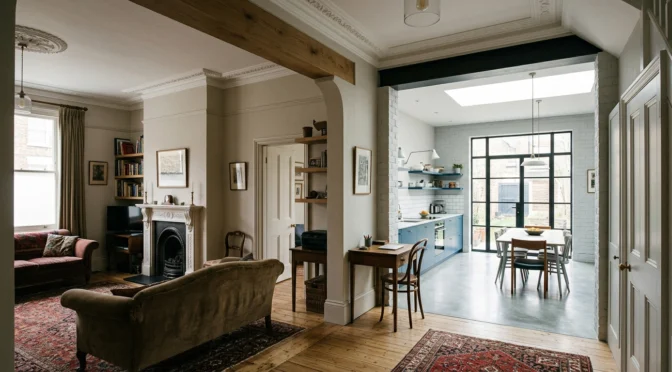
Should you open up a Victorian terrace or keep separate rooms? It is one of the biggest layout decisions you can make when renovating a period London home. Open-plan living can make a property feel brighter and more spacious, but removing walls isn’t always the best way to use a Victorian house.
The right choice depends on the property’s original layout, natural light, how you use each room and what you want from the renovation.
What Are the Benefits of Keeping the Original Rooms?
Why can separate rooms work well in a Victorian terrace?
Victorian terraces were generally designed with distinct rooms serving different purposes. Keeping some of these divisions can preserve the character and proportions that make the property appealing in the first place.
A separate dining room, for example, can create a dedicated space for entertaining, while a living room can remain quieter and more comfortable for everyday use.
Keeping walls can also give you more flexibility with furniture and allow different rooms to have their own atmosphere without making the entire ground floor feel like one large space.
When does opening up the layout make sense?
Opening up the ground floor can work particularly well when the existing rooms feel dark, disconnected or too small for modern living.
Removing a wall between a kitchen and dining area, for example, can create a more social space where cooking, eating and entertaining happen together.
However, the decision shouldn’t be based purely on the idea that open-plan automatically means better. The property’s proportions and structural layout need to be considered first.
This is where interior architecture becomes important. Looking at the structure, circulation and relationship between rooms can help determine whether removing a wall genuinely improves the home.
Can you create an open feel without removing every wall?
Yes. You don’t necessarily have to choose between completely open-plan and fully separated rooms.
A wide opening, glazed partition, internal doorway or carefully positioned furniture can create a visual connection while maintaining some division between spaces.
This can be particularly effective in Victorian properties where retaining architectural details is an important part of the renovation.
How Should You Decide Which Layout Is Right for Your Victorian Home?
What should you consider about everyday life?
Think about how your household actually uses the ground floor.
If you regularly cook while entertaining guests, an open kitchen and dining area may make sense. If different family members need quiet areas at different times, keeping separate rooms could be more practical.
Consider noise, privacy, entertaining, working from home and storage before deciding which walls should stay or go.
Could the decision affect the rest of the renovation?
Absolutely. Changing the layout can influence lighting, heating, flooring, kitchen positioning, storage and the movement between rooms.
It is therefore better to make the decision early rather than after other elements of the renovation have already been designed.
If you’re planning a larger project, a house renovation needs to be considered as one connected process, with the layout informing the decisions that follow.
Is there a middle ground between open-plan and traditional layouts?
Often, this is the most successful option.
You might retain a formal front reception room while opening up the rear of the property into a kitchen, dining and living space. This preserves some of the Victorian character while creating a more practical area for modern family life.
You should also consider the sequence of decisions during the renovation. Understanding the renovation order can help prevent expensive changes later.
Ultimately, there isn’t a universal answer to whether a Victorian terrace should be opened up. The best layout is the one that respects the property’s architecture while making it work better for the people living there.
For some homes, that means opening up the rear of the house. For others, keeping the original rooms may be exactly what makes the property special.

