


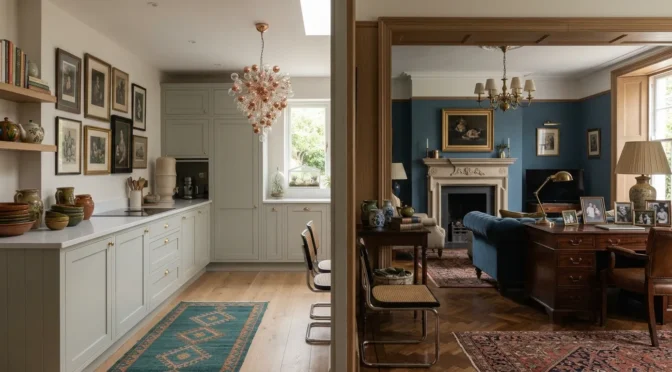
Yes, different rooms can have different interior design styles. In fact, a home can feel far more personal when the bedroom, kitchen, living room and dining room each have their own character. The trick is making sure they still feel as though they belong to the same home.
The goal isn’t to make every room match. It’s to create connection without repetition.
Should Every Room in a House Match?
Not at all.
A calm, minimalist bedroom can sit comfortably alongside a more colourful living room. A contemporary kitchen can work with a traditional dining room, particularly in a period property.
Trying to make every room identical can actually make an interior feel predictable.
Instead, think of the whole house as a conversation between different spaces. Each room can have its own personality while sharing a few visual details with the others.
How Do You Make Different Styles Work Together?

The easiest way is to repeat certain elements throughout the property.
For example, you might use:
- Similar timber tones
- A consistent metal finish
- Related colours
- Repeated lighting details
- The same flooring across connected spaces
- Complementary fabrics and textures
The rooms don’t need to look the same. They simply need a few common threads.
A navy blue living room and a neutral bedroom, for example, could still feel connected if both use warm timber, brass detailing and similar natural textures.
Can a Modern Kitchen Work With a Traditional Living Room?

Absolutely.
This combination can be particularly effective in London homes.
Imagine a contemporary kitchen with simple cabinetry and stone worktops opening into a living room with an original fireplace, traditional mouldings and more classic furniture.
Rather than fighting each other, the two styles can highlight the architecture of the property.
The transition can also be softened through flooring, lighting, artwork or a shared colour palette.
What About Bedrooms?
Bedrooms are often a good place to introduce a slightly different mood.
Your living room might be sophisticated and structured, while the bedroom can feel softer and more relaxed.
You could introduce warmer colours, textured fabrics, upholstered furniture or softer lighting without having to repeat exactly what you’ve done elsewhere.
The important thing is that the bedroom still relates to the overall home.
Is It Better to Have One Style Throughout the House?

There isn’t one correct answer.
Some homeowners prefer a consistent contemporary aesthetic throughout every room. Others enjoy discovering something different as they move around the house.
For larger properties, using slightly different styles can actually help individual spaces feel more purposeful.
A formal dining room can feel more elegant, a family room more relaxed and a study more atmospheric, while the overall property remains cohesive.
This is particularly important in residential interior design, where the design needs to reflect the personalities and routines of the people living there.
When Do Different Styles Start Looking Disconnected?
Problems usually appear when there is no relationship between the rooms.
For example, an ultra-modern monochrome kitchen, a rustic farmhouse dining room and a brightly coloured maximalist bedroom might each look attractive individually but feel confusing when placed together without any connecting elements.
You don’t necessarily need to remove one of the styles.
Instead, introduce shared materials, colours or finishes that create a visual bridge.
Should You Plan the Whole House Together?

Ideally, yes.
Even if you’re renovating one room at a time, having an overall direction can prevent expensive design mistakes later.
A professional residential interior design approach considers how rooms relate to one another rather than treating every space as an isolated project.
At Oraanj Interiors, we look at the property as a whole while giving individual rooms their own identity. Where construction or significant alterations are involved, our design and build services can also help ensure the design remains consistent through to the finished space.
So, Can Different Rooms Have Different Styles?
Yes, and they often should.
Your home doesn’t need to look like one large showroom. It should reflect the different ways you use each room and allow your personality to come through.
Think of your interior as a collection of chapters rather than one repeated sentence.
Different styles can work beautifully together when there is a clear thread connecting them.

