


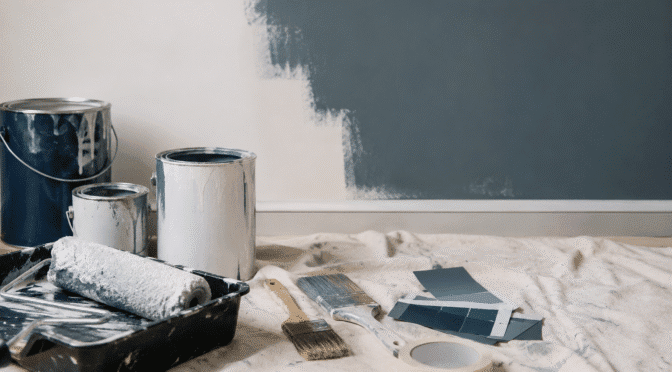
Bad painting advice spreads remarkably fast. It gets passed on by well-meaning friends, repeated endlessly in DIY forums, and followed confidently by homeowners who ultimately end up with peeling walls, patchy finishes, and wasted weekends.
Before you embark on your next decorating project, whether that is a single-room refresh or a full home renovation in London, here are ten common house painting myths that are well worth leaving behind for good.
Why Doesn’t Premium Paint Always Cover in One Coat?
Premium paint is chemistry-backed and undeniably worth buying. However, the widely circulated idea that one single coat is always enough in real-world conditions is a complete fallacy.

The bold coverage claims printed on tins are meticulously tested on perfectly sealed, laboratory-prepared surfaces. Authentic London walls, which have been repaired, repainted multiple times, and are naturally uneven in places, almost always require two coats for a consistent finish. It is highly recommended to budget for two coats right from the start.
Why Is Primer Essential Even with Self-Priming Paints?
Self-priming paint works reasonably well in absolutely ideal conditions. However, most domestic walls are far from ideal.
Fresh plaster, bare timber, significant colour changes, and any surface marred with stains or marks all require a dedicated, high-quality primer. Without it, the new paint will absorb unevenly, adhesion will suffer, and the overall finish will deteriorate far sooner than it ever should.
When Should You Remove Painter’s Tape to Get Crisp Lines?
This remains one of the most common house painting mistakes, yet it is also one of the easiest to avoid.

Dried paint forms a continuous, plastic-like film across both the tape and the adjacent wall. Peeling it away once dry pulls that delicate film with it, leaving a rough, jagged edge behind. You should always remove your tape whilst the final coat of paint is still slightly wet, pulling it back steadily at a 45-degree angle. This guarantees a clean, sharp line every time.
Must Ceilings Always Be Painted Flat White?
White ceilings are a common habit, certainly not an architectural rule.
Painting the ceiling in the exact same tone as the walls, a technique known as colour drenching, creates a cosy cocooning effect that works beautifully in living rooms and master suites. If you are unsure which white paint to choose for a traditional space, keeping the ceiling tonal rather than stark white is highly effective. In a smaller room, a ceiling painted slightly lighter than the walls draws the eye upward, making the space feel significantly taller. It is easily one of the most affordable home design ideas available to any homeowner.
Will Your Paint Colour Match the Shade on the Card?
Paint colours behave completely differently once they are applied to your unique walls.
Natural daylight, ceiling height, flooring tones, and the colours in adjoining rooms all affect how a shade reads in a space. A warm grey that looks incredibly sophisticated in a showroom can easily appear cold, flat, or even slightly blue in a north-facing room. Before committing to a scheme, it is wise to choose the right colour palette by painting large swatches on several walls and observing how they shift at different times of the day. To help inspire your choices, you can explore the best interior colour schemes for London homes.
Can You Paint Straight Over Existing Paint?
You should only attempt this if the existing surface is entirely sound, clean, and well-adhered.
Any flaking, bubbling, or peeling paint must be fully scraped and sanded down before anything new goes over it. Glossy surfaces also require a light sanding to give the new coat a textured surface to grip onto. Skipping this tedious prep work is the single most reliable way to ensure a freshly decorated room looks tired and peeling within twelve months.
Does Applying More Coats Always Guarantee Better Results?
Piling on extra layers of paint actually creates more problems when the initial surface preparation has been neglected.
An excessive build-up of paint layers can easily cause the surface to crack, bubble, and peel under temperature shifts. Two properly applied, thin coats on a well-prepared surface will always outperform four thick coats applied carelessly.
Does the Quality of Your Brush or Roller Really Matter?
Using the wrong tools will produce highly visible, unsatisfactory results on your walls.
Synthetic brushes are perfectly suited to water-based emulsion paints, whilst natural bristle brushes perform much better with oil-based glosses. Similarly, short-nap rollers give a smooth, flawless finish on flat walls, whereas long-nap rollers are absolutely necessary for textured or heavily plastered surfaces. Using a thick, long-nap roller on a smooth wall leaves an orange-peel stippled texture that no amount of sanding or extra coats will easily disguise.
Is It Impossible to Paint in Winter or Humid Conditions?
Cold temperatures and high humidity levels merely affect the drying time of your paint, rather than stopping it from working entirely.
Most modern water-based paints perform exceptionally well down to around 10°C. The key requirements are ensuring adequate ventilation, avoiding direct condensation on the wet surface, and allowing a much longer drying time between coats. For exterior projects in London, dry winter days above 5°C with low humidity are the practical threshold.
Is Painting Always a Straightforward DIY Project?
Simple, modern rooms in excellent structural condition are great for a weekend DIY project. However, more complex environments deserve much more careful consideration.
High ceilings, historic cornicing, dramatic colour transformations, specialist finishes, and rooms forming part of a wider residential interior design project are all situations where professional decorating pays for itself in the exceptional quality of the finished result.
Are You Ready to Plan Your Next Renovation Project?
Achieving a flawless paint finish always comes down to meticulous preparation, utilising the right materials, and following expert advice. If your next painting project is part of a wider renovation or complete redesign, book a free consultation with Oraanj Interiors. Our team will help you plan a breathtaking space that is truly worth living in.

